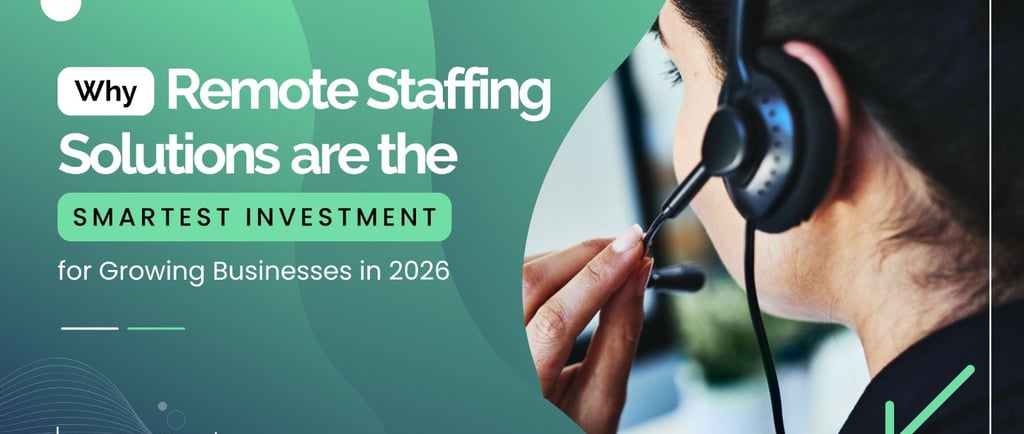
Why Remote Staffing Solutions Are the Smartest Investment for Growing Businesses in 2026
operacy
6/26/20264 min read
Businesses in 2026 face a familiar challenge: how to grow without dramatically increasing costs. Rising labor expenses, talent shortages, changing customer expectations, and the need for greater flexibility have forced companies to rethink traditional hiring models. Instead of relying solely on in-house employees, many organizations are turning to remote staffing solutions to build skilled, agile teams that support sustainable growth.
Remote staffing is no longer viewed as a temporary response to workplace changes. It has become a long-term business strategy that allows companies to access global talent, improve efficiency, and remain competitive in an increasingly digital marketplace.
The Evolution of Remote Staffing
A few years ago, remote work was considered an alternative to office-based employment. Today, it has become an integral part of how businesses operate. Advances in cloud technology, project management platforms, communication tools, and cybersecurity have made it easier than ever for distributed teams to collaborate effectively.
Businesses are realizing that success depends less on where employees are located and more on the systems, processes, and skills they bring to the organization. This shift has accelerated the adoption of remote staffing solutions, enabling companies to recruit professionals with specialized expertise regardless of geographic boundaries.
Access to a Larger Talent Pool
One of the biggest limitations of traditional hiring is geography. Companies often compete for a limited number of qualified candidates within their local area, making recruitment expensive and time-consuming.
Remote staffing removes these barriers by allowing businesses to hire professionals from a global talent pool. Whether the need is for project managers, administrative assistants, customer support specialists, digital marketers, software developers, accountants, or designers, organizations can find experienced professionals with the right skills instead of settling for whoever happens to be available locally.
This broader access to talent often leads to better hiring decisions and stronger long-term business performance.
Lower Operational Costs Without Compromising Quality
Hiring full-time in-house employees involves much more than salaries. Businesses must also account for office space, equipment, utilities, insurance, recruitment costs, employee benefits, training, and ongoing overhead expenses.
With remote staffing solutions, many of these costs are significantly reduced. Companies can invest their resources in technology, innovation, customer experience, and business development instead of expanding physical office infrastructure.
Reducing operational expenses does not mean sacrificing quality. Many remote professionals have years of industry experience and work within structured performance management systems that ensure consistent productivity and accountability.
Greater Business Flexibility
Market conditions can change quickly. Seasonal demand, new projects, business expansion, or unexpected economic shifts often require organizations to adjust their workforce.
Remote staffing provides the flexibility to scale teams up or down based on business requirements. Instead of committing to lengthy hiring processes or maintaining excess staffing during slower periods, businesses can build teams that match current workloads.
This agility enables organizations to respond faster to opportunities while minimizing unnecessary financial risk.
Improved Productivity Through Specialized Support
Business owners and senior managers frequently spend valuable time handling repetitive administrative work that does not directly contribute to revenue growth.
Delegating tasks such as scheduling, customer support, data entry, bookkeeping, research, CRM management, and document preparation allows leadership teams to focus on strategic priorities like business development, customer relationships, and innovation.
Many companies achieve this by implementing outsourced business support solutions, which allow skilled remote professionals to manage operational responsibilities efficiently while internal teams concentrate on higher-value work.
Rather than replacing existing employees, outsourced support often strengthens internal operations by reducing workloads and improving overall productivity.
Business Continuity and Risk Management
Unexpected disruptions—from natural disasters to local workforce shortages—can impact daily operations. Businesses that rely entirely on one office location or a single hiring market may struggle to maintain productivity during challenging situations.
Remote teams naturally provide greater resilience. Distributed workforces reduce dependency on one location, allowing business operations to continue even when individual regions experience disruptions.
In addition, remote collaboration tools enable businesses to maintain communication, monitor performance, and manage projects from virtually anywhere, supporting stronger business continuity planning.
Technology Makes Remote Collaboration Easier Than Ever
The success of remote teams depends on effective communication and project management. Fortunately, modern technology has eliminated many of the barriers that once made remote work difficult.
Platforms for video conferencing, instant messaging, cloud storage, task management, customer relationship management, and workflow automation enable remote employees to collaborate almost as seamlessly as office-based teams.
When businesses establish clear processes, measurable goals, and regular communication routines, remote teams often achieve productivity levels equal to—or even higher than—traditional office environments.
A Competitive Advantage in 2026
Businesses that embrace flexible workforce strategies gain an important competitive advantage. Faster hiring, lower operating costs, improved scalability, and access to specialized expertise all contribute to stronger business performance.
As industries become increasingly digital, organizations that can quickly adapt to changing customer needs will be better positioned for long-term success. Remote staffing solutions allow businesses to remain agile while maintaining high service standards and operational efficiency.
Companies that continue relying solely on traditional hiring models may find themselves facing higher costs, slower recruitment, and increased difficulty attracting top talent.
Choosing the Right Remote Staffing Partner
While remote staffing offers significant benefits, success depends on choosing the right partner. Businesses should look for providers that understand their industry, carefully vet candidates, maintain clear communication processes, and prioritize long-term workforce integration rather than simply filling positions.
A successful remote staffing strategy is built on trust, transparency, and ongoing collaboration. When remote professionals become an extension of the internal team, businesses often experience stronger productivity, improved employee satisfaction, and sustainable growth.
Final Thoughts
In today's competitive business environment, growth requires more than increasing headcount—it requires smarter resource management. Remote staffing solutions provide businesses with access to global talent, lower operating costs, greater flexibility, and the ability to focus on strategic priorities that drive long-term success.
Combined with effective outsourced business support solutions, remote staffing enables organizations to streamline operations while remaining responsive to changing market demands. As businesses continue to evolve in 2026, investing in a flexible and skilled remote workforce is no longer simply an option—it has become one of the smartest decisions companies can make to achieve sustainable growth.
Connecting businesses with skilled virtual assistants.
GET IN TOUCH
Email: info@operacy.net
Phone: +1(587) 936-2761

Working Hours : 9AM - 5PM
Working Days : Mon - Sat